How Do You Know Which Type of Fencing Is Right for Your Property?
Choosing Fencing That Suits Its Purpose and Surroundings
The right fence should do more than mark the edge of a property. It may need to provide privacy, contain pets, define a driveway, reduce noise or create a secure boundary. Because different fencing styles perform different roles, appearance alone should not guide the decision.
For property owners in Lakenheath, Suffolk, the most suitable choice will depend on how the space is used, the level of exposure, the ground conditions and the amount of ongoing maintenance expected. Considering these factors before installation can result in a boundary that remains practical and visually appropriate.
Begin With the Fence’s Main Purpose
Identifying the primary purpose of the fence helps narrow the available options. A low decorative boundary has very different requirements from a solid rear garden fence or an enclosure intended for animals.
Consider whether the fence needs to:
- Increase privacy
- Define the property boundary
- Contain children or pets
- Restrict access
- Reduce exposure to wind
- Separate different parts of the garden
- Complement a rural setting
- Screen bins, equipment or working areas
- Reduce noise entering the property
- Incorporate a pedestrian or driveway gate
One fence may need to perform several of these functions, so the most important requirements should be prioritised.
Wood Fence Panels for Defined Garden Boundaries
Traditional fence panels provide a straightforward way to create a clear, enclosed boundary. They are available in different styles and can offer a useful balance between privacy and appearance.
Panels are commonly suited to rear and side gardens where consistent sections are required between posts. Individual damaged panels can also be replaced without rebuilding the entire fence, provided the posts and gravel boards remain sound.
Their performance depends heavily on secure posts and correct installation. Exposed areas require particular attention because solid panels receive considerable wind pressure.
Feather Edge Fencing for Continuous Privacy
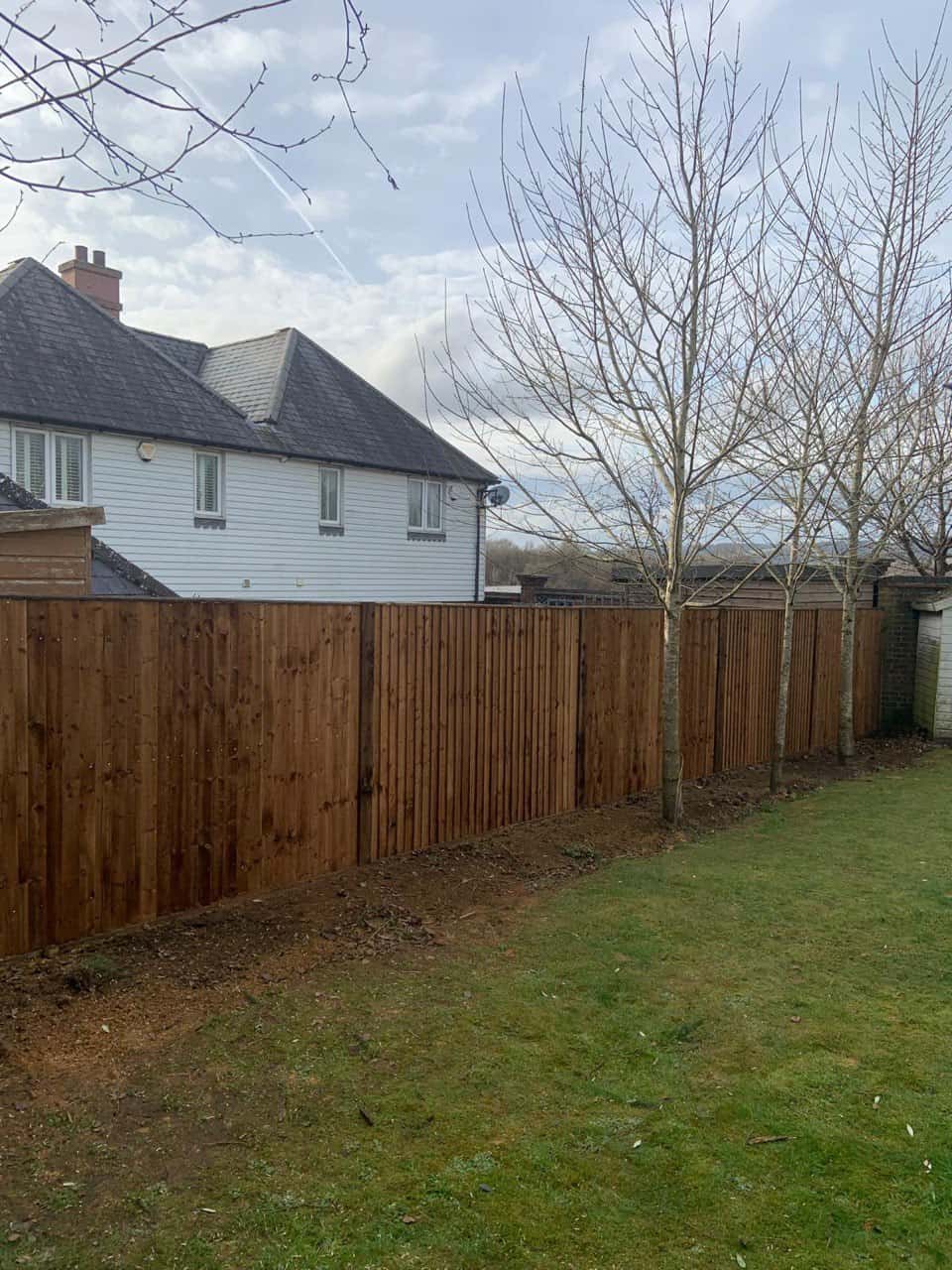
Feather edge fencing is constructed from overlapping vertical boards fixed to horizontal rails. It creates a continuous boundary that can follow gradual changes in ground level more naturally than standard rectangular panels.
This style is well suited to:
- Long garden boundaries
- Sloping or uneven ground
- Areas requiring substantial privacy
- Boundaries where individual panel sizes would be restrictive
- Properties needing a robust, traditional appearance
Because the boards overlap, the finished fence has no regular panel joints. Its strength still relies on correctly spaced posts, suitable rails and secure fixings.
Picket Fencing for Decorative Separation
Picket fencing is generally lower and more open than privacy fencing. It defines an area without making it feel completely enclosed, making it suitable for front gardens, paths and internal garden divisions.
The gaps between the boards allow light and views to pass through. This can make a smaller space feel less restricted while still creating a clear boundary.
Picket fencing may not be suitable where full privacy or strong screening is required. The size and spacing of the openings should also reflect whether the fence needs to contain a small pet.
Post-and-Rail Fencing for Open or Rural Settings
Post-and-rail fencing has a simple, open construction that suits larger gardens, paddocks and land where visibility needs to be retained. It defines an area without creating the solid appearance of close-boarded fencing.
It can be adapted with suitable mesh where greater containment is required. The posts must be installed securely because long runs and changing ground conditions can place strain on the rails.
This type of fencing is most appropriate when an open character is desirable and privacy is not the main objective.
Stock Fencing for Animal Containment
Stock fencing uses wire mesh supported by posts to enclose animals or protect certain areas. The mesh specification should be selected according to what the fence needs to contain or exclude.
Effective stock fencing depends on:
- Correct post spacing
- Secure corner and end assemblies
- Suitable mesh height and opening size
- Consistent tension
- Appropriate gates
- Ground clearance that does not create gaps
The layout should also allow practical access for maintenance and movement through the enclosed space.
Acoustic Fencing for Noise Reduction
Where external noise affects the use of a garden, acoustic fencing may offer more benefit than an ordinary solid panel. It is designed to reduce gaps through which sound can travel and typically uses a dense, closely fitted construction.
Its effectiveness depends on the fence’s:
- Height and position
- Continuity along the boundary
- Absence of gaps
- Density and construction
- Relationship to the source of the noise
Acoustic fencing should be assessed as part of the wider site. A short or poorly positioned section may provide less benefit than a carefully planned continuous barrier.
Bespoke Fencing for Unusual Layouts
Standard fencing may not suit every property. Changes in level, restricted access, curved boundaries and existing trees or structures can all make a tailored design more appropriate.
Bespoke fencing can also coordinate several elements, such as privacy sections, decorative panels and matching gates. The aim is not simply to create something different, but to produce a practical solution for a space that standard sections cannot address effectively.
Consider Wind Exposure
Solid fencing provides privacy but catches more wind than an open design. On an exposed boundary, inadequate posts or shallow foundations can lead to leaning, movement and repeated panel damage.
A suitable design should consider:
- Fence height
- Length of the exposed run
- Post material and dimensions
- Post spacing
- Ground stability
- Open or slatted alternatives
- Nearby buildings that redirect airflow
Choosing stronger panels alone will not resolve a weakness caused by unsuitable posts or installation.
Assess the Ground Conditions
Soft, wet, sloping or disturbed ground can affect how securely fence posts remain in position. Tree roots, old foundations and changes in level may also influence the installation method.
A professional assessment should identify these conditions before the fence style and support system are finalised. This helps prevent avoidable movement and creates a more consistent boundary.
Think About Maintenance
Timber fencing needs occasional inspection and suitable care. The lower sections are particularly important because persistent contact with damp soil can accelerate deterioration.
Useful maintenance considerations include:
- Whether individual components can be replaced
- How easily both sides can be accessed
- Whether vegetation will grow against the fence
- The use of gravel boards to separate panels from the ground
- The suitability of timber or concrete posts
- How frequently finishes may need attention
The most appropriate fence is one that the property owner can maintain realistically.
Include Gates in the Initial Design
Pedestrian and driveway gates should be planned with the fence rather than added as an afterthought. Gate width, opening direction, ground clearance and post strength all affect everyday use.
A heavy gate requires suitable support, while access routes should remain practical for vehicles, bins, garden equipment and pedestrians. Matching the gate to the fencing can also create a more unified appearance.
Conclusion
Choosing the right fencing begins with understanding what the boundary must achieve. Wood panels and feather edge fencing provide privacy, picket fencing creates decorative separation, and post-and-rail or stock fencing suits more open forms of enclosure. Acoustic and bespoke fencing can address more specific site requirements.
If you are considering new fencing for a property in Lakenheath, Fast Fix Fencing Lakenheath can assess the layout, ground conditions and intended use before recommending a suitable option. A properly considered design can provide a practical boundary without including features that the property does not need.
Call us on: 01842 771 088
Click here to find out more about Fast Fix Fencing Lakenheath
Click here to complete our contact form and see how we can help with your fencing needs.